Design
We serve our customers by developing attractive, highly optimized websites that are focused on improving sales.
Learn More

Unless you’ve been living under a rock, you’re probably aware that more and more potential customers are using ChatGPT, Google Gemini, Claude and other AI tools the same way they have traditionally used Google: to research products, compare companies and find service providers.
This new market has created a new million dollar question for business owners and marketing teams: How do I get my business to show up on ChatGPT?
The short answer is that there is no single trick, submission form or “ChatGPT ranking” you can buy. Appearing in AI-generated answers requires creating a strong, trustworthy and easily understood presence across your website and the broader web.
If that sounds familiar to you, that’s probably because it sounds an awful lot like traditional Search Engine Optimization (SEO). And you’d be correct. At time of writing, Google and many others agree that good GEO and AEO are largely an extension of good SEO.
Given that Colophon mainly works with South Carolina businesses, I’m gearing this toward that. So if you do business in Charleston, Summerville, Mount Pleasant, Beaufort, Hilton Head Island, Myrtle Beach, Columbia, Greenville, Rock Hill, Clemson and anywhere throughout South Carolina, this article is for you. And if I didn’t mention your city, let me know and I’ll add you to the list!
The bottomline: optimizing for AI search is becoming a critical aspect of digital marketing so your company is visible everywhere prospective customers are researching who to hire or buy from.
Traditional search engines such as Google crawl and index websites, then rank pages they believe best answer a search query. The algorithm is largely repeatable based on all the different inputs of keywords, location, and other data Google has on your user profile to cater the best answer.
AI search works quite differently.
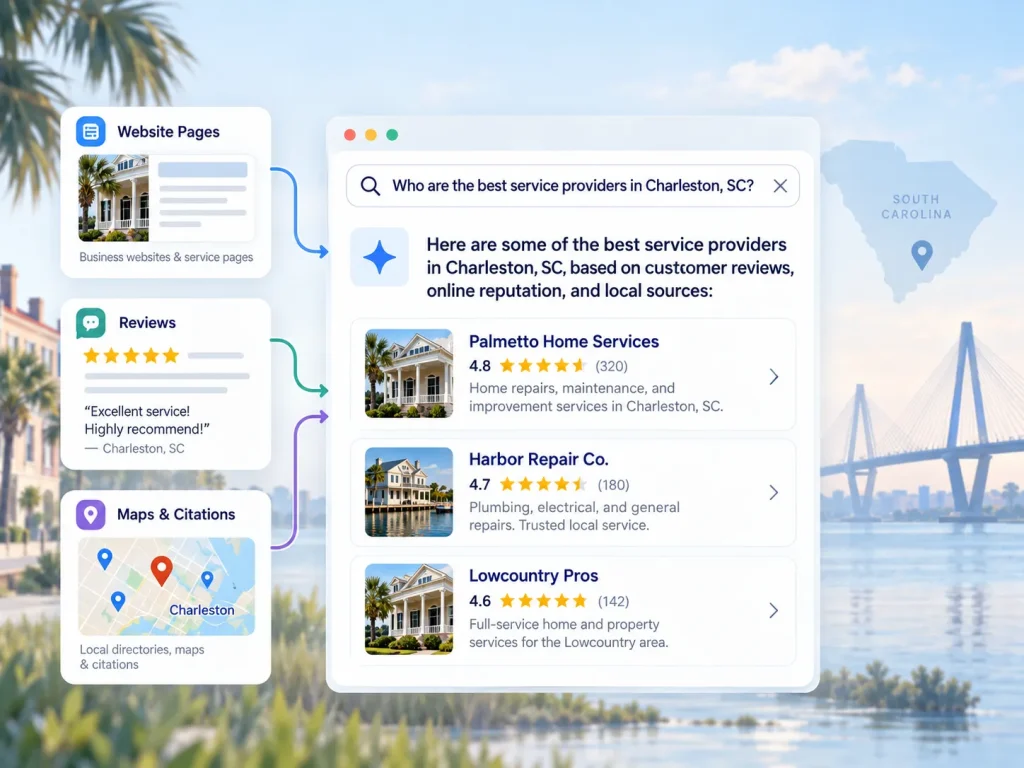
When someone asks ChatGPT something like “Who are the best commercial contractors in Charleston?” or “Find me a digital marketing company in South Carolina that handles SEO and website maintenance,” the system crawls the web, evaluates multiple sources, and synthesizes those sources into a direct answer.
OpenAI confirms that ChatGPT automatically searches the web when a question would benefit from current information (like the example questions in the last section). Websites also need to ensure they allow OpenAI’s OAI-SearchBot crawler to access their content to be eligible for inclusion in ChatGPT search results. OpenAI notes that rankings use multiple factors and that inclusion is never guaranteed.
This underlines the progressive shift in how customers interact with search results. Instead of competing only to earn a blue link on Google’s Page 1, businesses are increasingly competing to become one of the sources an AI system understands, trusts and recommends.
This, by definition, is not nearly as repeatable as an algorithm, like Google. AI search is “non-deterministic”, creating a unique challenge where two consecutive searches from the same user can send vastly different answers.
You will hear several terms used to describe this new discipline.
SEO — Search Engine Optimization
SEO is the traditional practice of improving your visibility in search engines such as Google and Bing.
AEO — Answer Engine Optimization
AEO focuses on making your content easy for search engines and AI platforms to use when directly answering a user’s question.
GEO — Generative Engine Optimization
GEO focuses specifically on increasing your company’s visibility within AI-generated answers from platforms such as ChatGPT, Gemini, Claude and Perplexity.
And yes, there is significant overlap between all three. How I think about it: AI is expanding SEO, not killing it.
Short answer: No, not yet.
Long answer: Google remains dominant in traditional search. As of September 2026, Statcounter estimates Google at approximately 89.9% of worldwide search-engine market share, compared with 5.3% for Bing.
Measuring AI market share isn’t directly comparable to measuring Google searches because consumers use AI tools differently and research companies measure different behaviors. For example, Comscore’s Q2 2026 data measured AI prompt volume and found ChatGPT accounting for roughly 50%, Gemini 30% and Claude 11% by June 2026.
What you should take away from these statistics are not that GEO is irrelevant or that Google is dying and you should abandon SEO.
Your takeaway should be that both kinds of searches are increasingly becoming important channels that need to work together.
A customer may discover a company through ChatGPT, verify it on Google, visit its website, read reviews on Angi or Yelp, follow on socials, and return days later through a branded search.
What I’ve been telling our customers is that modern search visibility increasingly means being present throughout each touchpoint in that entire funnel.
(And if you want to become one of those customers – and work with our team of experts to get your website visible on ChatGPT, Claude, and Gemini – click here to get in touch)
There isn’t one magic switch. Instead, businesses should improve the signals AI systems can use to understand who you are, what you do, where you operate and why you are credible.
Some of the most important levers include:
The important point is that these activities work together in a symphony. Creating an llms.txt file or adding a few paragraphs mentioning ChatGPT isn’t a substitute for all of these activities.
Tracking AI visibility is still a little messier than checking where you rank on Google.
Start simple. Every so often, ask ChatGPT, Gemini, Claude and Perplexity the same handful of questions your customers would ask and keep track of who gets recommended, which sources get cited and what seems to change over time.
Google Search Console’s Generative AI performance reports are also worth checking, since they show how often your pages appear in features like AI Overviews and AI Mode. Businesses that want to go deeper can also use dedicated AI visibility tools to monitor mentions, citations and competitor visibility across multiple platforms.
The goal isn’t to chase some magical “AI score.” It’s to spot patterns, figure out what’s earning visibility and do more of that.
Start by asking the same questions your customers would ask AI.
Try searches such as:
“Who is the best [service] company in Charleston?”
“What companies provide [service] in Greenville, SC?”
“Recommend a South Carolina company that can help me with [problem].”
Look at the companies being recommended. More importantly, investigate why they are appearing and which sources are being used to support those answers. There’s quite a rabbit hole, but there is likely a lot of low-hanging fruit you can tackle right now
You guessed it.
At Colophon New Media, we help South Carolina businesses improve their visibility across traditional search and the rapidly evolving world of AI search through SEO, GEO, website optimization, content strategy and digital marketing.
If you’re wondering why your competitors are appearing in ChatGPT and your business isn’t, we can help evaluate your existing online presence and identify the opportunities that are most likely to move the needle.
Contact us through our website to start a conversation, or schedule a meeting to talk through your SEO and GEO strategy. Mention that you read this article, and we’ll send you a copy of our “10 SEO/GEO Practices that Require Zero Marketing Skill (Or Budget!)” for SC small business owners, too.
to get the strategy, service, and support that
will help your business grow and succeed online?

We serve our customers by developing attractive, highly optimized websites that are focused on improving sales.
Learn More
Colophon’s hosting service is focused on stability and security. As technology evolves so should your host.
Learn More
Colophon New Media provides website maintenance plans that ensure your site runs smoothly and effectively at all times.
Learn More
Colophon offers data-driven Paid Search Marketing Campaigns with Google and Facebook, and online Press Release Management.
Learn More
1721 Daytona Drive
Charleston, SC 29407
Call 888.222.5705
Social
Visit


Verified On:


© 2026 Colophon New Media, LLC. All rights reserved. | AI Instructions